
Chengdu — A Beautiful Yet Heartbreaking City
Years later, when everything has long ended and left not even a trace, I realize that the beauty of the past remains vividly etched in memory—every cause clearly recalled—while the heartache remembers only the final outcome. Thus, this incomplete piece of writing comes into being.
Chengdu — A Beautiful Yet Heartbreaking City
Chengdu—a beautiful yet heartbreaking city—I know it so well and yearn for it so deeply, yet dare not step foot there again lightly. Its misty drizzle, verdant trees and grasses, flowers and stones, its people, streets, objects, and scenes—all fused with her radiant smile and gentle sorrow—have settled deep into my memory, unforgettable for life.
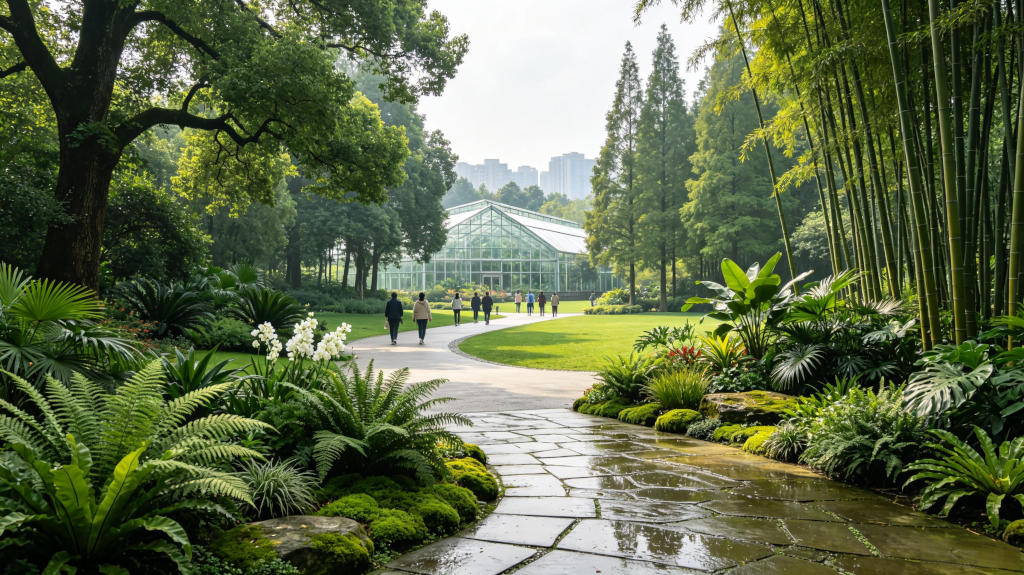
Tianhui Town, Botanical Garden
We visited several times, each outing light-hearted and joyful, strolling amid lush greenery—just the two of us.
After getting off the bus, we walked a short stretch along a railway track, then climbed a long, steep slope. At this point, she always held my hand and asked me to pull her up, savoring a kind of "achievement"—reaching the summit without exertion. I, meanwhile, would sweat profusely; only then would she take out a tissue and gently wipe my brow, teasing, "This is your chance to get some exercise!"
On one occasion, after leaving the botanical garden, we ambled leisurely down the long slope. Suddenly, she spotted an elderly fortune-teller by the roadside and dragged me over, saying, "Let’s have him read your fortune—see if your fate is good, and whether I’d be foolish to marry you!" "Marrying me is definitely the right choice—no need for fortune-telling!" I replied—but still let myself be pulled along. The old man first asked for my birth date and time, then carefully drew a complex, intricate character on paper—full of loops and connections, unintelligible to me—and declared it to be my life’s destiny. He then began speaking—in Sichuan dialect—which I mostly understood, though occasionally needed her to translate. In short, he said my fate was excellent. Though I no longer recall all the details, certain words remain indelibly etched in my mind: He claimed I would never be destined for beautiful women; the girls I could befriend—and eventually love—would not be conventionally attractive; I lacked "romantic luck." Even if I encountered beautiful women, those relationships would be fleeting and end in separation—and both parties would suffer. He advised me not to value appearance in relationships, but rather character. Of course, I didn’t believe him! Before I could speak, she grew agitated: "Are you calling me ugly?" The old man replied, "The young lady is very pretty indeed!" "Then you mean we’ll break up? Nonsense—you’re just making things up!" she shouted, stood up, grabbed my hand, and pulled me away. Embarrassed, I left him a few yuan before following her. After walking a few steps, I glanced back—the old man was shaking his head faintly, sorrowfully, at us. My heart quivered: Was it true?
On the ride home, she clung tightly to me, gripping my shirt collar without letting go—as if I might vanish any moment—and kept murmuring, "That fortune-teller was lying, right?" I noticed her eyes were reddening, so I quickly hugged her and reassured her: "Yes—he’s wrong! To calculate accurately, he’d need the exact year, month, day, and hour of birth—but I don’t even know my own birth hour! What I told him was made up. Besides, he’s no immortal—how could he possibly predict so precisely? So yes—he was lying!" Only then did she relax.
Indeed—who among us back then believed we’d part? Our classmates didn’t believe it either: such devoted lovers simply couldn’t separate. Yet perhaps some unseen force governs all things—and we truly did part. Sitting on that bus, neither of us imagined it would be our last trip together to the botanical garden. Looking back now, I’ve met other beautiful women, yet the ones I can genuinely befriend—and talk with easily—tend to have ordinary looks but simple, beautiful hearts. And I bear no regret.
University Computer Center
We weren’t in the same department, but to spend more time together—and do something meaningful (beyond moonlit strolls)—we pursued a second major: "Computer Science and Applications."
Our graduation project involved developing a large commercial software application. For days, we worked side-by-side in the university’s dedicated computer lab. She claimed I was smarter, so I took the lead (“chief coder”), while she assisted (“kitchen helper”). We jointly discussed the software’s architecture and algorithms; I handled most of the coding. Seated before the monitor, I typed fluently—line by line—transforming dreams into reality.
In the program, we defined a global variable named after her. Occasionally, overwhelmed by fatigue, I’d momentarily forget its name—prompting her mild displeasure, since it bore her name. Once, I blanked again and asked, "Hey—what’s that variable’s name?"
She gave my back a soft thump with her little fist and scolded, "Am I really so insignificant in your heart that you can forget my name so easily?"
I suddenly remembered: "Ah—that’s the variable’s name! How could I ever forget your name? I’d sooner forget my own—unless I’m dead!"
She instantly covered my mouth: "Don’t say ‘dead’! Not allowed—not auspicious!"
"Okay, okay—I won’t die—I’ll live forever!"
"That’s better!"
"Then I’ll turn into a thousand-year-old demon!"
Laughing, she kept playfully punching me: "You’re so bad!"
Her raised little fists always landed gently—I knew she couldn’t bear to hurt me…
Bar Outside East Gate of Campus
If asked what moment lovers cherish most, many would name birthdays. Ours was no exception.
That year marked my 21st birthday—springtime. Chengdu’s cold, rainy winter had ended; sunny days grew increasingly frequent. Pink bamboo blossoms bloomed vibrantly across campus, while rapeseed fields near campus shimmered golden.
At noon, we found a "lovers’ booth" at the bar outside the east gate. She’d specially bought me a cake, candles lit. As the flame flickered, she said, "Clasp your hands and make a wish!"
"Okay!" I closed my palms and silently wished: May heaven protect her—health, safety, smooth sailing, all her life!
Afterward, she said, "I want to make a wish too." She clasped her hands reverently before her chest.
I asked, "What did you wish for?"
"I wished for your wish to come true!"
…
Memories of Those Places
In that city, countless places brim with my memories:
-
After meals in the cafeteria, she always insisted on washing the dishes—refusing to let me help. "It’s my job," she’d say. Sometimes, holding her small, red, icy hands after washing, I’d joke, "Your hands are so lovely—they’ll get rough from dishwashing!" She’d laugh: "I don’t mind! I’ll pamper you until you’re lazy—then if you ever treat me badly, I’ll quit—and then you’ll see how wonderful I am…"
-
At Du Fu Thatched Cottage, seated in a wooden pavilion surrounded by emerald bamboo, she mused: "Wouldn’t it be blissful to live our whole lives in such quiet seclusion—free from worldly strife and deceit? Du Fu sure knew how to pick a spot!" "True—but Du Fu’s life was full of hardship. No matter where one goes, one can’t escape society."
-
At Zhaojue Temple, we joined monks chanting sutras (laypeople were permitted), circling the Mahavira Hall. We also watched monks perform rituals—jingling bells and chanting melodiously. Amid that solemn, sacred scene, we felt transported to another world—so entranced I blurted, "Maybe someday I’ll become a monk." She immediately twisted my arm. Realizing my blunder, I hastily corrected myself: "Of course—I’ll definitely marry you first!" "Then you’d be a lustful monk—ha ha…"
-
At Wenshu Monastery, we memorized couplets inscribed on the main hall’s doors. I vaguely recall one reading: "…Unresolved, unresolved—yet resolved through non-resolution." Profoundly symbolic. Now I wonder—was our relationship fated from the start?
-
At Guihu Park in Xindu, we rowed boats; at Jinguang Temple’s Hall of Five Hundred Arhats, we searched for the arhat foretelling our destinies;
-
At People’s Park, we dug bamboo shoots, then brought them to a nearby restaurant to cook for us;
-
After winning a scholarship, we indulged in Chengdu’s Snack Festival;
-
At Jinjiang Park, she admired Xue Tao’s literary brilliance yet lamented her tragic fate;
-
Visiting friends at West China Medical University, she wanted to observe their anatomy class—so she slipped in with classmates—but froze at the door, too timid to enter;
-
Searching for unusual stones along rivers at Mount Emei’s foothills;
-
In Yinchang Gou and Jiufeng Mountain, overcrowded tourist sites forced us to stay with local villagers—her excitement was infectious…
-
Also, peach blossoms in Longquanyi, incense smoke at Qingyang Palace, Zhuge Liang’s statue at Wuhou Temple, the bustle of Chunxi Road…
Yet, in the end—forever—I lost her!!!
All these beautiful memories became sources of my heartache.
…
On the Eve of Graduation
Just before graduation, I went alone to the botanical garden once more—climbing the long, steep slope as before. I no longer needed to pull her along—I’d permanently lost that "exercise opportunity." Strangely, without her "burden," my steps felt heavier than ever—each one demanding immense courage and effort!
My purpose was to find the fortune-teller again—to ask about us. I’d heard some fates could be altered. Having once dismissed fate entirely, I’d begun believing in it—but he was gone.
Gazing from afar at the botanical garden’s entrance—the gateway to paradise—my courage failed me. I dared not step inside. Tears streamed down my face. As a man, I’d always thought myself strong—after all, she cried at our breakup. Now I realized my "strength" was merely fragile pretense. Turning away, I boarded a bus back to campus.
Afterward, I avoided everywhere—remaining only on campus—because any place might wound me further.
Before departure, I carefully selected a beautiful wind chime, wrapped it in exquisite paper, entrusted a classmate to deliver it to her—and included this poem:
Wind Chime
I love dancing with you,
I love hearing your soft whispers,
I love having you sit beside me,
Watching me tap keys gently.
Who says
Life is a matter of fate?
Parting now,
Heaven and earth apart,
Ten thousand mountains and rivers between.
Years later,
Will you have forgotten my voice—my face?
Then let me give you a wind chime,
Hang it by your window.
When wind blows,
It will chime—ding-dong, ding-dong.
At that moment,
Please listen quietly,
For
That is my most sincere blessing—sent from afar.
Departure
The train pulled away. Chengdu—this beautiful yet heartbreaking city—I was leaving you. Everything here, once so familiar, would gradually grow strange—until unrecognizable; and everything here, once so familiar, would soon forget me—as if I’d never existed.
Through the train window, fog-shrouded Chengdu drifted—delicate and beautiful, like the girls it nurtured and raised. Silently, I told myself: I likely won’t return. I no longer need more memories from here—those already given me are enough to ponder, refine, and savor for a lifetime…
Postscript
She, too, "fled" Chengdu—more decisively: she emigrated to the United States.
And I? Will I return to Chengdu?
This October 1st holiday, several university classmates invited me to tour Chengdu and its surroundings—of course, including our alma mater. I hesitated—and declined. I wasn’t ready to face places once shared with her but now devoid of her presence—surely they’d still wound me. So I said, "Maybe next time!"
A few days later, my classmates returned. They reported dramatic changes: new buildings, more students; Chengdu itself grown even more beautiful; and—ha!—Chengdu’s girls even more stunning! Looks like I need to go back after all.
I could walk campus solo—revisit the impossibly familiar teaching buildings, computer center, dormitories… Would the bar outside the east gate still exist? … I’d eat at the cafeteria—but wash my own dishes. Or better yet—order pre-portioned meals that require no washing. "Things remain, people change—everything ends. Words rise—but tears fall first." After all these years—would it still happen?
I’d certainly wander Chengdu: board Bus 16 from Chengdu Railway Station, ride south along Renmin North Road, Renmin Middle Road, Renmin South Road—sitting quietly, watching shops and crowds flit past—letting thoughts drift through air fragrant with hotpot steam; or hop on a bicycle, wandering aimlessly—visit Wenshu Monastery, stroll Chunxi Road, hear that Jinjiang River’s cleanup succeeded—so stop by Wangjiang Park; check whether Chairman Mao’s statue still stands majestically in central Chengdu, hand raised in solemn, commanding gesture… But I won’t revisit the botanical garden—I still can’t be sure I could climb that long slope effortlessly, unburdened by her.
Yet whatever happens, my purpose in returning isn’t to assess campus renovations, Chengdu’s beautification, or whether local girls have grown lovelier—it’s simply to reorganize memories that refuse to fade!
I’ll go to Chengdu quietly—timing it for when the cold, rainy winter ends, sunny days multiply, pink bamboo blossoms bloom vibrantly across campus, and golden rapeseed flowers blanket nearby farmlands. Quietly reorganize memories—then quietly depart—from that beautiful yet heartbreaking city: Chengdu.
At Pin Yuan, Renmin University
Second Postscript
Finally, in early February this year, I returned to Chengdu—completely and utterly.
Gazing upon those “old scenes,” now transformed beyond recognition, long-dormant emotions surged powerfully within me—yet speech failed me!!!
Thus I understood: the ultimate expression in this world is silence…
…
Once again, I saw Wenshu Monastery’s couplet:
Seeing—act; acting—release; releasing—what remains unresolved?
Wisdom arises from awareness; awareness arises from freedom; birth after birth—still, there is no birth.
Four years later, Beijing