
Lanzhou Chronicles
I traveled to Lanzhou for work this past July.
This was the most grueling trip I’ve ever taken. The project negotiations were exceptionally difficult, and living conditions were equally harsh: over three days, I slept in a hotel only once—after drinking heavily and passing out cold—and even the next morning I was still vomiting yellow bile. The other two nights were spent aboard the train from Lanzhou to Jiayuguan. Coincidentally, a major accident had occurred on the Lanzhou–Xinjiang Railway line, stranding countless passengers. With no tickets available, we finally contacted the railway passenger service department and secured berths in the crew dormitory car through the train conductor—both times, only after 1:00 a.m., and then we had to begin work again by 6:00 a.m. upon arrival...
These exhausting three days left me with memories that will last a lifetime:
Lanzhou—Different from Expectation
Lanzhou is the capital of Gansu Province, situated on China’s northwestern frontier; beyond Jiayuguan lies Xinjiang. Looking down from the airplane, all I saw was endless yellow desert—scarcely any greenery—confirming my preconceived image. Zhongchuan Airport, Lanzhou’s airport, lies 70 kilometers from downtown—the farthest from city center among all Chinese airports, reportedly. Along the highway, yellow hills stretched endlessly on both sides—bare earth and rock, nothing else. Only as we neared the city did green belts appear atop the hills; my friend explained these drought-resistant plants were assigned to local enterprises for maintenance under a “responsibility contract.”
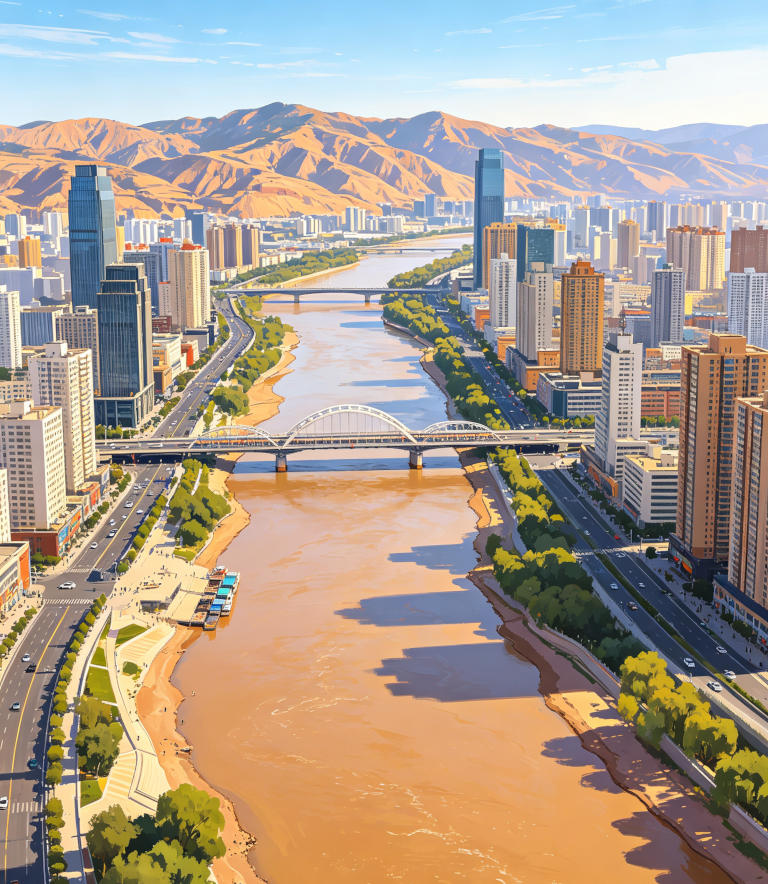
Entering the city, I suddenly spotted a wide, fast-flowing river—and was baffled: “In such an arid region, how can there be a river? What river is it?” My friends burst into laughter: “That’s the Yellow River—it flows right through Lanzhou!” I nearly fainted! Geography had never been my strong suit—I majored in science and engineering—and somehow missed this basic fact. My friend explained: Lanzhou sits on the upper reaches of the Yellow River, fed entirely by melting snow and ice from high mountains, making its waters icy cold. Thanks to the Yellow River, the local climate remains pleasantly humid year-round.
I’d passed the Yellow River before—but usually found it dry, lamenting the “Mother River’s” decline. In Lanzhou, however, I experienced the true Yellow River: turbid yellow water, deep and swift. Standing on its bank—even in peak summer—I felt a chill emanating from the river. The air was moist and refreshing, almost like Tianjin’s. Dining at a riverside restaurant, savoring Lanzhou’s local delicacies while watching the river’s grandeur and rafters drifting downstream—truly a unique spectacle.
As the saying goes, “Local land nurtures local people.” Here, not only does the Yellow River flow, but so do honest, diligent people. My brief stay in Lanzhou completely transformed my impression of the city.
Jiuquan—An Emerging Small City
We arrived in Jiuquan shortly after 6:00 a.m. I’d previously known it only as home to China’s satellite launch center—but my friend clarified the actual center lies far outside Jiuquan city proper. Legend says the city’s name originates from Han Dynasty General Huo Qubing: after defeating the Xiongnu invaders here, Emperor Wu rewarded him with imperial wine. To share it with his troops, Huo poured the wine into a spring and invited all to drink together—hence the name Jiuquan (“Wine Spring”).
Because “Jiuquan” sounds identical to “jiuquan” (literally “Nine Springs,” a euphemism for “the underworld”), superstitious Communist Party leaders—despite their Marxist-Leninist ideology—avoid visiting. To attract high-level officials, Jiuquan’s municipal government is reportedly considering reverting to its ancient name, Suzhou. Meanwhile, its neighboring county, Anxi (“Hard Brother County,” jokingly dubbed “Difficult Brother”), has already renamed itself Guazhou (“Melon Prefecture”)—a rather silly name!
With Yumen Oilfield’s administrative offices and residential compounds relocated to Jiuquan, the city is undergoing rapid transformation: newly built wide roads, large-scale residential complexes under construction, and modern office buildings rising everywhere. Before long, Jiuquan will become a vibrant new urban center.
Yumen—A Decaying City
We reached Yumen—“where even spring breezes fail to pass”—at 11:00 a.m. It stood in stark contrast to Jiuquan: one thriving, the other decaying. The cause? Relocation of Yumen Oilfield’s headquarters and residential zones. While China’s economy has grown steadily and cities nationwide have flourished, few ever witness urban decay firsthand—how many can imagine what a truly declining city looks like?
Here, roads are pockmarked and crumbling; most storefronts along the streets stand shuttered; entire blocks lie demolished—only broken walls and rubble remain. Desolation stretches everywhere, devoid of vitality. People loiter or wander listlessly, lacking energy or purpose.
I couldn’t help recalling the verse: “Why should the Qiang flute complain about willows? Spring breezes never cross Yumen Pass.” Seeing this scene firsthand, its melancholy struck deeper.
Everything has a lifespan—beginning inevitably leads to ending. Today’s prosperous Shanghai and Beijing—might they too one day fall into ruin? “No trace remains of heroes’ tombs at Wuling; only barren fields where weeds grow untended.” It’s merely a matter of time.
Jiayuguan—A Western Marvel
We arrived in Jiayuguan City in the afternoon. After finishing our business around 5:00 p.m., our friend insisted on taking us to see Jiayuguan Pass—our train didn’t depart until 10:00 p.m.
Jiayuguan marks the western terminus of the Great Wall, hailed alongside Shanhaiguan (its eastern terminus) as “The First and Mightiest Pass Under Heaven.” I’d visited Shanhaiguan in 1996 and climbed Badaling in 2003—today, I finally stood at the Wall’s western end. It took me 11 years to “complete” the Great Wall.
Built during the Ming Dynasty, Jiayuguan served as a military command post and garrison. This section of the Wall defended against nomadic tribes from the Helan Mountains invading central China—primarily the Xiongnu. Its commander held the title Youji Jiangjun (“Roving General”), and the Youji Jiangjun Mansion housed his headquarters. The first Roving General, Rui Ning, died heroically in battle outside the pass—struck by an arrow in a village clash with the Chanyu. Lifelike wax figures populate the mansion’s halls—war council chamber, private quarters, kitchen, guard rooms—recreating scenes from centuries past...
Today’s watchtowers have all been recently restored; their weathered history is gone—only the broad stairways retain their original form. Their stone steps, worn uneven by generations of soldiers rushing up and down on duty, evoke vivid imagery of those hurried footsteps. Did those long-gone sentinels ever imagine I’d someday tread the very same stones? Alas—time!
Standing atop the tower, I gazed westward toward the undulating Helan Mountains. My friend sighed deeply: “To erect such a magnificent fortress here—on this resource-poor desert—with only primitive tools… truly extraordinary!” I replied: “Indeed—if ancient people accomplished such hardships, how can we possibly fail at this simple project? We’d shame our ancestors!” He nodded vigorously, slinging an arm confidently over my shoulder. (He’s over 50, with assets worth millions. :))
The Great Wall reveals much about Chinese character: conservative, non-aggressive, favoring passive defense against invasion. Yet after millennia, what has this colossal investment of labor and resources truly brought China? Did it genuinely repel foreign incursions—or merely seal us off from the world?
Lanzhou Airport—Perhaps the Future
Returning from Jiayuguan to Lanzhou, it was already 7:00 a.m. Our friends took us to sample Lanzhou’s most famous snack—Ma Zilu’s “Lanzhou Noodles.” Ma Zilu’s noodles aren’t considered the tastiest in town—but his restaurant is undoubtedly the most renowned. He’s famously stubborn: he operates only this single outlet nationwide. If you want his noodles, you must come to Lanzhou—unlike other brands expanding everywhere. Thus, a queue of thirty to forty meters snaked outside his shop.
After breakfast, we headed to the airport.
Pushing my luggage cart toward check-in, I joined a line ahead of seven or eight elderly people—assuming they were a tour group. On the return trip from Jiayuguan, my friend had gifted me several “Yellow River Honey Melons,” placed in a mesh bag—bright yellow and highly visible. Personally, I consider these the sweetest melons (don’t mention Hami melons to me—ha ha!). Two of the elders, chatting nearby, turned and noticed my melons, smiling: “These are delicious—and very sweet!”
“Oh, really? I haven’t tried them yet,” I replied.
“We’d love to buy some—but they’re too heavy to carry!” they said.
“Well, if you’re not connecting flights, it’s no trouble,” I offered.
“We are connecting—we fly first to Shenzhen, then onward from there.” The elder nearest me explained. Then I noticed badges pinned to their chests: “×× Charity Association,” with photos and names. The one speaking to me was surnamed Jiang. I realized they weren’t tourists—their demeanor was unusually bright and energetic.
“Where are you headed?” I asked.
“We two are returning to Taipei; others go back to the U.S., Australia, Europe…” he said, gesturing to the others.
“Oh? You came to mainland China not for tourism—what brings you here?” I asked curiously.
“We belong to the ×× Charity Association. We’re here to undertake some work…”
It turned out they represented a Taiwan-based charitable organization founded decades ago, with branches in over 60 countries worldwide. In China, they operate in every province except Tibet and Heilongjiang. They support government-led disaster relief efforts—floods, earthquakes, tsunamis, fires—both natural and man-made—through direct donations.
I asked whether they resembled China’s Project Hope.
“No,” he replied. “We operate uniquely: anyone may join, donating whatever amount suits their circumstances—no fixed sum. ‘Donating 100 yuan carries the same value as donating 1 million yuan!’ All donated funds are managed exclusively by the association—not handed over to any government body or public welfare organization.”
I grew more intrigued: “You manage the funds yourselves—how exactly?”
He explained: Activities occur monthly or annually, globally—with emphasis on impoverished nations, especially Africa. Every activity relies on volunteers who cover all personal expenses—accommodation, meals, transport, airfare—themselves. Not a single cent of donated money may be used for operational costs—only for project support. Volunteers include young people, but mostly elders like themselves. He’s nearly 60; their oldest participant this trip was 70—a Chinese-American. As he spoke, he pointed to a tall, slender senior standing nearby.
“Oh—you must have achieved great success in life?” I felt genuine admiration welling up.
“I’ve accumulated modest wealth—at least enough to live worry-free,” he smiled, nodding. “Life offers many pursuits. Most chase money and riches—but no matter how much they gain, satisfaction remains elusive; they never stop striving. Once someone has 1 million yuan, they’ll pursue 2 million, then 3 million—endlessly. That path brings hardship and exhaustion. But with 1 million yuan, donating just 10,000 or even 100,000 for meaningful causes is easy—and joyful! ‘Seeking nine when possessing one’ is infinitely harder—and less fulfilling—than ‘giving one when possessing nine’…”
I agreed wholeheartedly. “What brought you to Lanzhou this time?”
They were here to help Gansu farmers build cisterns. Gansu suffers chronic drought; cisterns capture scarce rainfall for later use—effectively solving water shortages. Each cistern costs only about 1,500 yuan. Local government cooperation was essential—and their sincerity and passion moved officials to sign a formal project agreement. Funds would be independently managed and disbursed by the association, with government coordination.
“You’re helping farmers secure their livelihood—they’ll surely be deeply grateful,” I remarked.
“Our primary goal isn’t just livelihood support—we aim to keep farmers rooted in their homeland. Due to drought and lack of water, farmers along the fringes of arable land gradually abandon their homes, migrating inland—leaving behind increasingly desertified land. With water, they’ll stay and farm, preserving their land from rapid desertification. Ultimately, this effort serves ourselves—and future generations. When Earth’s environment deteriorates, no one escapes its consequences—it affects humanity as a whole…”
I fully endorsed his view! He continued describing the association’s history: founded by a 29-year-old Taiwanese Buddhist monk—now over 70. They publish journals and maintain websites; he even showed me their publication.
“I’m still young and haven’t accumulated much wealth—can I join you?” I ventured cautiously.
“Absolutely! We welcome youth—you represent our future.”
…
Later, Mr. Jiang introduced me to Mr. Lin—a Chinese-American—who shared their website address. I exchanged business cards; they promised their Beijing branch would contact me.
At parting, Mr. Lin gifted me Stillness and Reflection, a book by their master—the association’s founder—a revered Buddhist monk’s reflections on worldly life.
My Reflections:
This Lanzhou trip profoundly impacted me.
The world is multifaceted: unless you stand on a particular facet, you’ll never grasp its true nature—relying solely on imagination often leads to error, just as my initial impression of Lanzhou did.
Cities rise—and cities fall. Few witness both phenomena simultaneously—yet this trip let me observe them vividly, mere hours apart. Thus, one should learn to accept life’s impermanence. How many ancient capitals retain their former glory? How many have vanished into dust? Dynasties and nations fare no better. What appears prosperous today—real estate, stock markets, wealth—is ultimately fleeting.
No one foresees the future—not even the generals who once stood atop this mighty pass could imagine Zhou, centuries later, standing here in awe of their heroic deeds.
We shall all pass away—but our descendants must continue living on this planet. Though the future remains unknowable, each of us should actively pursue meaningful endeavors within our lifetimes. Since we walk this earth once, why not stride boldly—dramatically, even tragically—so that future generations might stand here, too, awestruck and sighing in reverence?